

Student Success
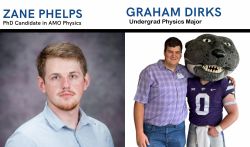
Two K-State Physics students have received awards from the U.S. Department of Energy (DOE). Graham Dirks, undergraduate in Physics, has been granted a Science Undergraduate Laboratory Internship (SULI) from the SLAC National Accelerator Laboratory. Zane Phelps, graduate PhD candidate with the JRM Lab, has been named an outstanding U.S. doctoral student by the Department of Energy Office of Science Graduate Research Program.
The SULI Program is sponsored by the DOE Office of Science's Office of Workforce Development for Teachers and Scientists (WDTS). The summer program at SLAC will be in-person and runs for 10 weeks. During the internship, each student works with a scientist or engineer on a project related to the Laboratory’s research program. At the conclusion of the internship, the student writes a research paper and makes a brief presentation on his or her project.
The DOE Office of Science has selected 79 outstanding U.S. doctoral students from 56 universities and 29 states for the prestigious Office of Science Graduate Student Research (SCGSR) program. SCGSR prepares doctoral candidates for careers of critical importance to the Office of Science’s mission of transforming our understanding of nature and advancing the energy, economic, and national security of the United States. Participants receive world-class training and access to state-of-the-art facilities, expertise, and resources at DOE's national laboratories.
Recently Published Papers:
-
Time-domain Measurement of Auger Electron Dynamics in Xenon and Krypton Atoms after Giant Resonance Photoionization
Mahmudul Hasan, Jingsong Gao, Hao Liang, Yiming Yuan, Zach Eisenhutt, Ming-Shian Tsai, Ming-Chang Chen, Hans Jakob Worner, Artem Rudenko and Meng Han
Physical Review Letters 136, 163201 (2026) -
Nonadiabatic Strong-Field Photoionization Revisited
Spencer Walker, Abdulaziz Alqasem, Abraham Camacho Garibay, Cosmin I. Blaga, Alexandra S. Landsman, and Louis F. DiMauro
Physical Review Letters 136, 123203 (2026) -
Imaging Three-Dimensional Molecular Structure and Dynamics with
Multiparticle Covariance and Cumulant Coulomb Explosion Analysis
Chuan Cheng, Yoshiaki Kumagai, Kiyonobu Nagaya, Tatsuo Gejo, James Harries, Michael Burt, Mark Brouard, Avijit Duley, Paul Hockett, Joseph W. McManus, Russell S. Minns, Subhendu Mondal, Shigeki Owada, Weronika Razmus, Daniel Rolles, Takahiro Sato, Henry J. Thompson, Anbu S. Venkatachalam, Emily M. Warne, Tiffany Walmsley, Mana Yagi, Philip Bucksbaum, Felix Allum, and Ruaridh Forbes
The Journal of Physical Chemistry Letters 17, 3605-3616 (2026)
This Week at JRM
Week of 16 Feb 2026
| Mon | 1:30 pm | Nuts & Bolts |
| News & status (Hybrid, CW119) | ||
| Tue | ||
| Wed | ||
| Thu | ||
| Fri | ||
What's New?

Daniel Rolles, professor in atomic, molecular, and optical physics, has been selected as a 2024 Fellow of the American Physical Society for pioneering experiments on imaging ultrafast molecular reactions with XUV and X-ray free-electron lasers, and for advancing our understanding of the interaction of ultra-intense X-ray pulses with atoms and molecules.