ECR Source
If you can read this, your browser is unable to properly import or use
Cascading Style Sheets (CSS). Please upgrade to a more modern browser.
Our electron cyclotron resonance ion source makes slow, highly-charged ions.

See more photos of the ECR in our Photo Gallery.
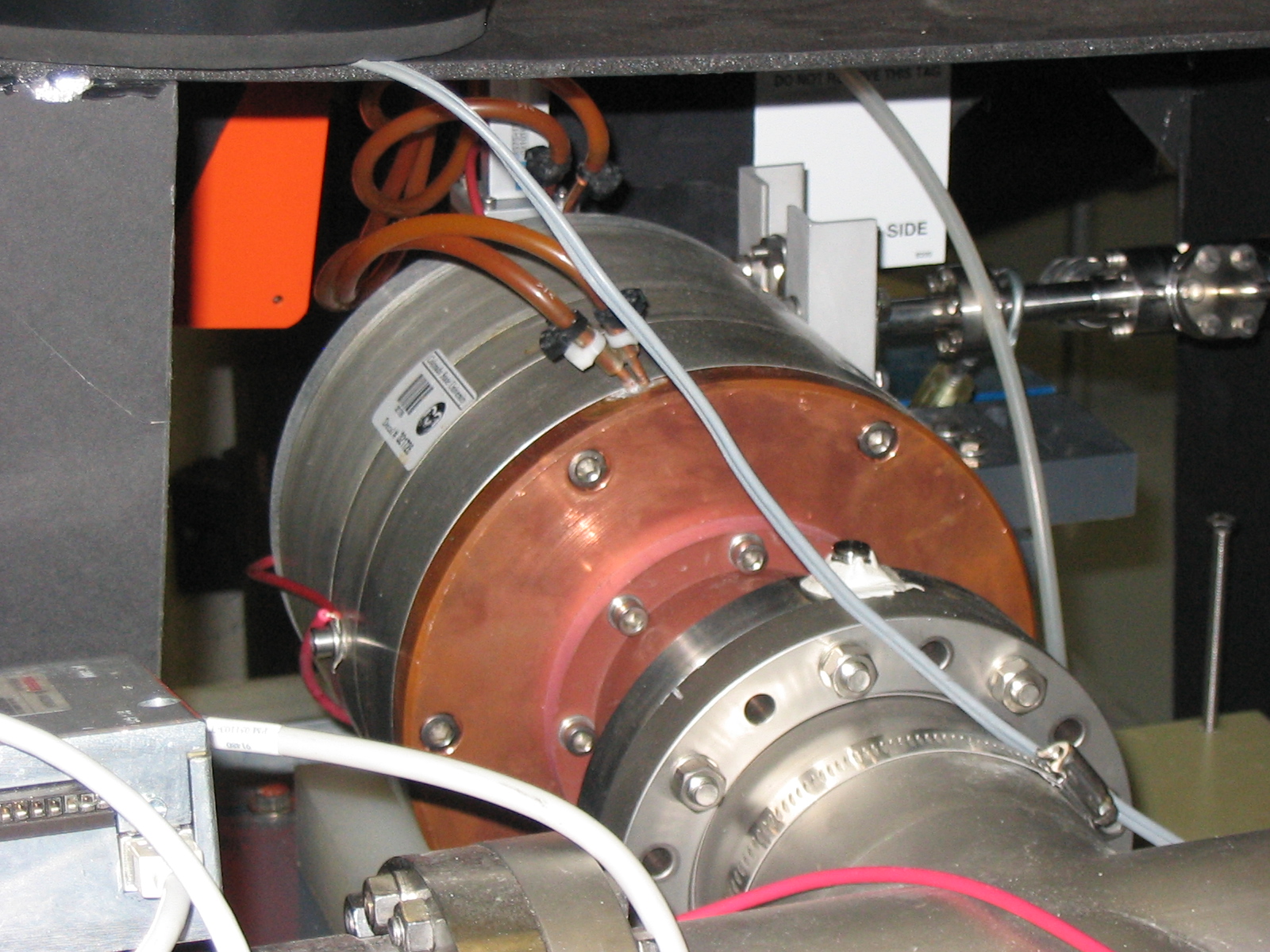
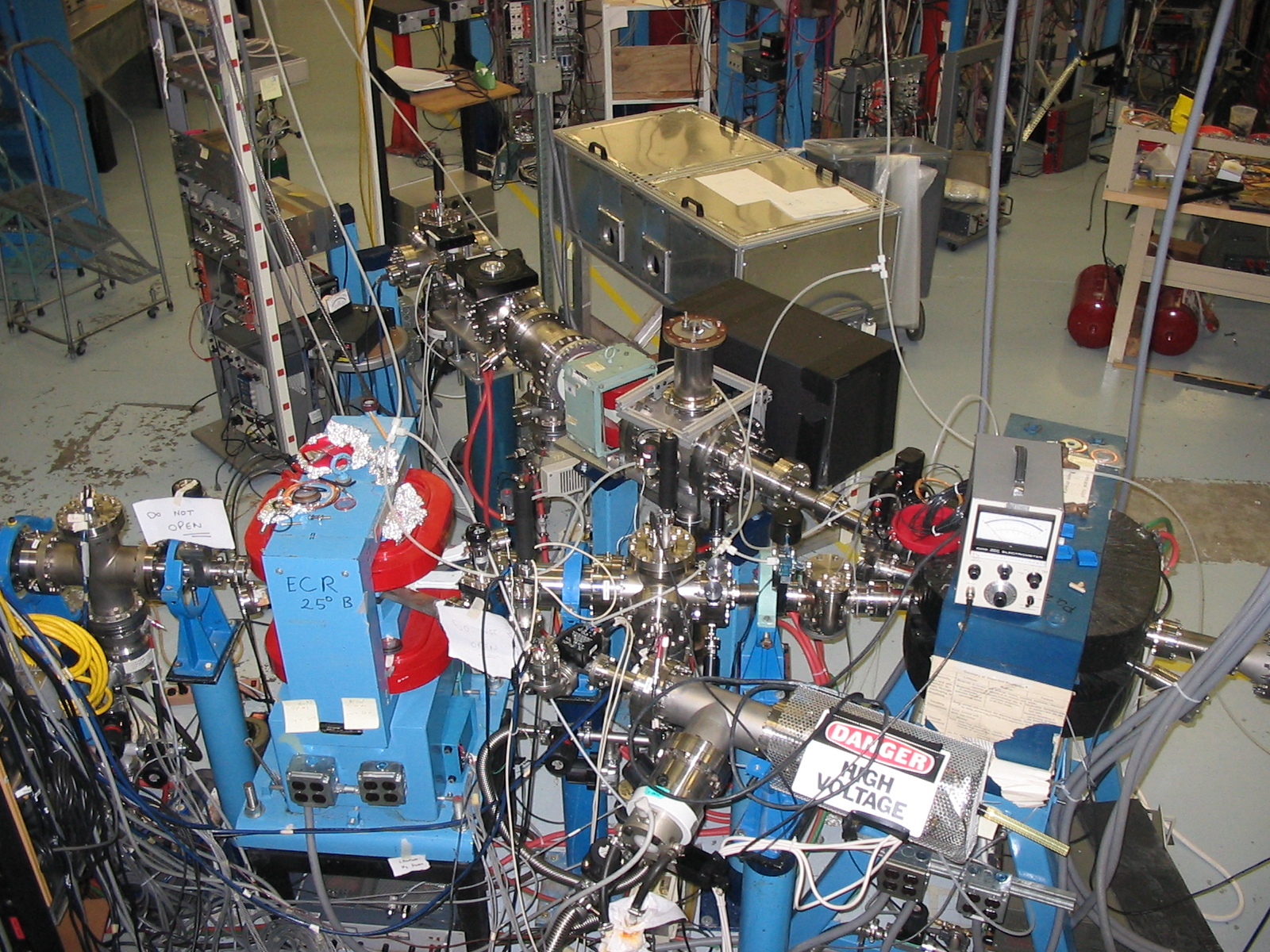
The Electron Cyclotron Resonance Source (ECR) is a plasma device designed to provide highly-charged ions at low velocities. The ECR source is smaller than the retired Cryebis , providing ions with lower mass and ultimate charge state, but with much greater beam current. The two devices and their crossed beamlines constituted the Low Energy Ion Collision Facility (LEICF), a unique apparatus for ion-ion collision experiments.
A solenoidal magnetic field provides azimuthal confinement of electrons and ions while a hexapole array of permanent magnets gives radial confinement. The ions within the trap region are bombarded by electrons excited by 5 GHz microwaves into electron cyclotron resonance (hence the name).
Our original ECR was designed and built by the group of Erhard Salzborn at the Justus-Liebig-Universitaet in Giessen, Germany. After many years of service, it has been retired. The new ECR is a commercial product manufactured in China. Charles Fehrenbach now heads the KSU ion-ion collision facility team.
The ion-ion collision system recorded its first data in November 1995, seeing He2+ from the ECR interact with He+ from a small Penning source. Useful beams of a variety of ions can now be reliably produced. The heaviest beam attempted so far is argon. The greatest charge state of Ar observed is 8+; the total current in all species and charge states is greater than 1 milliamp.
The ion-ion project is the legacy of the late Professor John Giese, who was taken too soon from us in July 1995 by the effects of cystic fibrosis.
Today the ECR and a small standalone source are used in combination with our various lasers to study photon-ion interactions by the group if Itzik Ben-Itzhak.
Last updated on Thursday, 31-Oct-2024

