Linac (Retired)
If you can read this, your browser is unable to properly import or use
Cascading Style Sheets (CSS). Please upgrade to a more modern browser.
Our retired superconducting linac used to accelerate or decelerate ion beams.
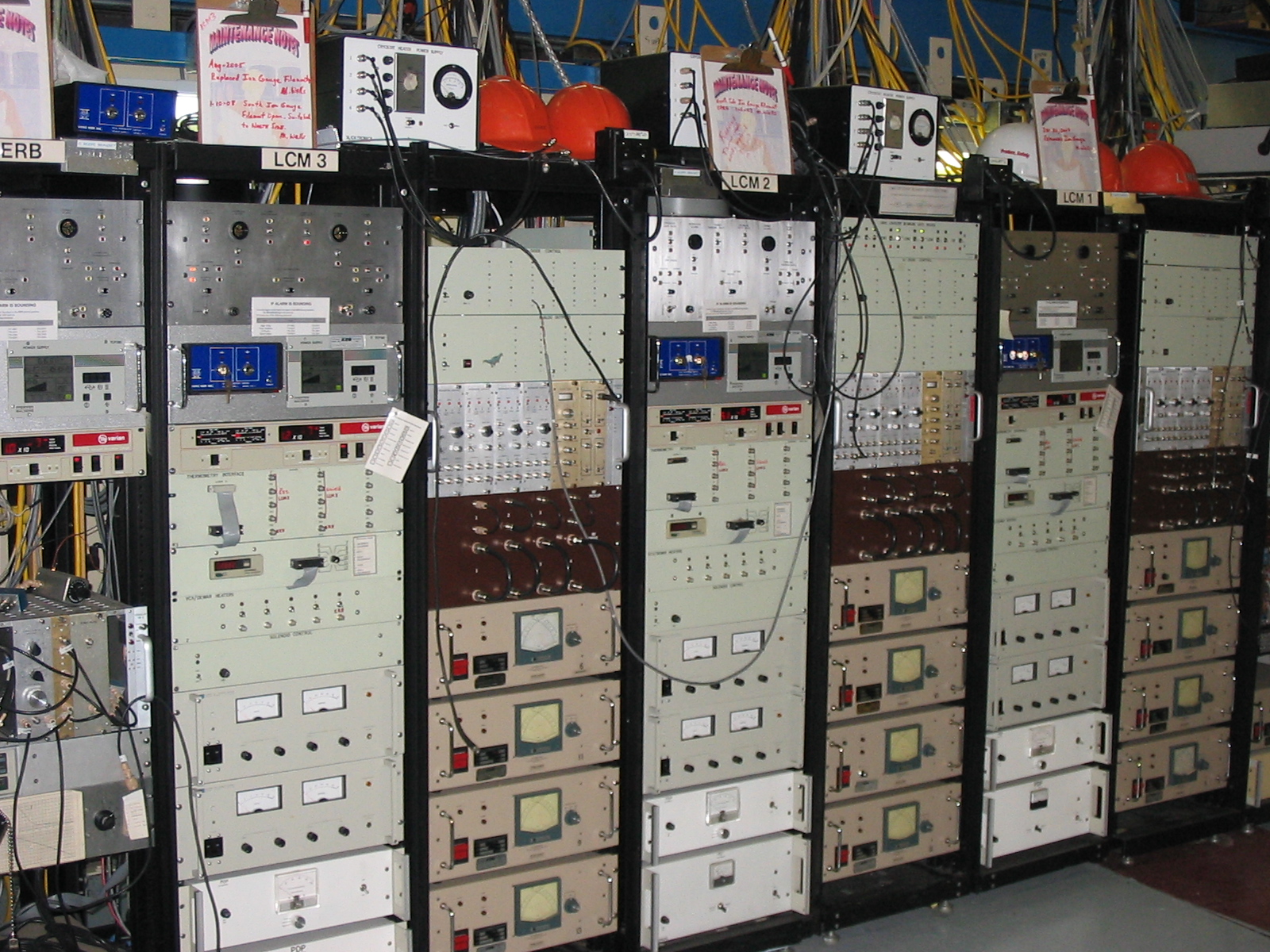
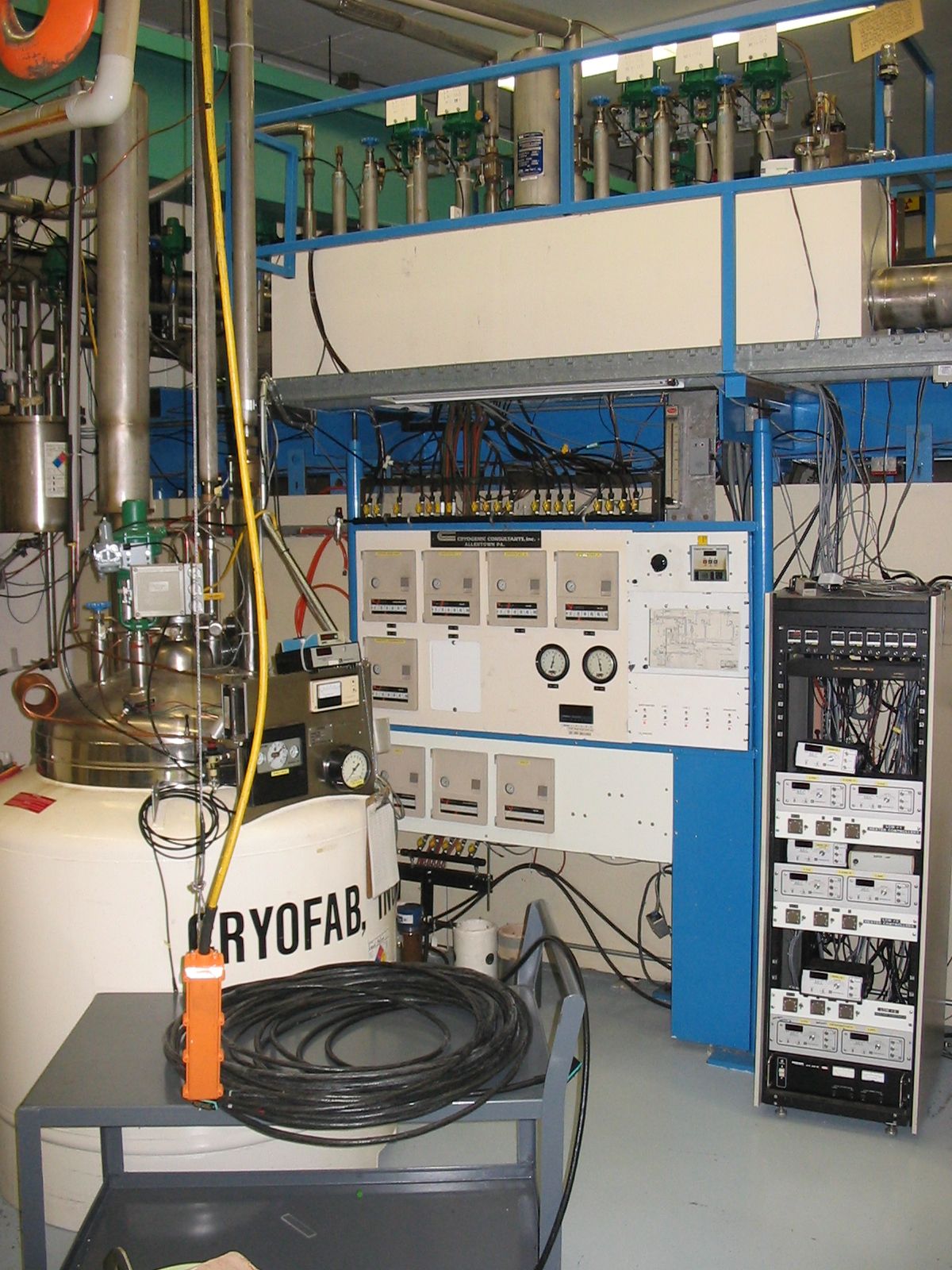

See more photos of the Linac in our Photo Gallery.
Note: With the laboratory's emphasis changing from ion-atom to photon-atom collisions, the superconducting linac has been retired. As of the end of 2009, we are recycling the peices and making room for further expansion of our laser systems. The discussion below is the original description of the linac, retained here for posterity.
The Tandem beams can be further boosted in energy by a superconducting linac "booster". The main body of the Linac consists of 12 niobium split-ring resonators, with a total active accelerating length of 3 meters (see cutaway drawing). Our current average electric field is about 2.5 MV/m. The resonators are a product of research by Ken Shepard, Lowell Bollinger and the rest of the ATLAS group at Argonne National Laboratory.
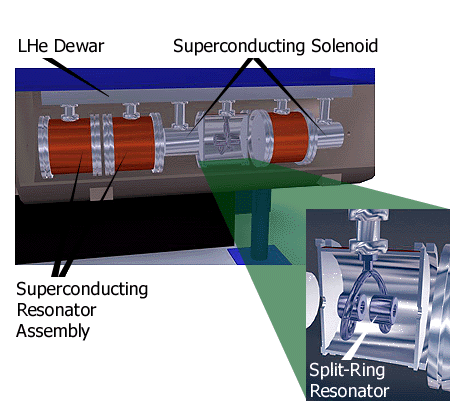
Two other resonators act as bunchers. The first compresses the Tandem beam to fit the Linac's acceptance. A typical time width for an injected beam is around 150 picoseconds. The other resonator is the last in the lattice and is used to tailor the beam characteristics for delivery to the target.
Liquid helium cooling is provided to the Linac by a CCI (now Cryo Technologies) helium refrigeration plant. This refrigerator gives about 300 watts of cooling without liquid nitrogen pre-cooling and about 600 watts with LN2. This plant also supports Cryebis operations. We have completed a major renovation of the He gas handling system, moving the noisy compressor off the laboratory roof and into a dedicated structure.
The Linac is now available for experiments in either accel or decel modes, with the unique decel capability attracting the most demand. Beams of F 9+ have been decelerated from 36 MeV down to about 10 MeV. The ultra-short pulses from the bunching system have been used by investigators to probe recoil-ion momentum distributions in remarkable detail.
The Linac project is managed by Kevin Carnes. The staff includes Mike Wells, Al Rankin and Vince Needham . Electronics support is provided by Kevin Carnes and Scott Chainey.
Last updated on Wednesday, 16-Dec-2009

