Past Features
If you can read this, your browser is unable to properly import or use
Cascading Style Sheets (CSS). Please upgrade to a more modern browser.
An archive of past featured research stories from our home page.
February 2024
Ultrafast Molecular Photoswitch
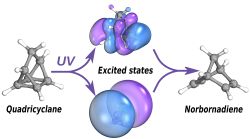
An international collaboration led by researchers from the Kansas State University Physics Department and the Oxford University Chemistry Department has studied ultrafast processes in the molecular photoswitch quadricyclane, published recently in Nature Chemistry.
Quadricyclane and norbornadiene are two isomers, that is molecules with the same chemical formula but different geometry, which interconvert upon absorption of ultraviolet light. Quadricyclane is the higher-energy isomer and can be used to store solar energy, which is then released by a catalytic process as heat. So-called molecular solar thermal (MOST) devices exploit such isomer pairs to, for instance, warm houses by absorbing energy from the sun during the day and then releasing it at night.
The experiment, led by Kansas State Physics professor Daniel Rolles and his graduate student Kurtis Borne, used ultrashort light pulses produced by the FERMI free-electron laser facility in Trieste, Italy, to track the conversion between the two isomers on a timescale of femtoseconds. The experimental results were interpreted with the help of state-of-the-art computer simulations done in Oxford. The combined study discovered faster than previously identified pathways leading to the conversion, which may help designing new ways of controlling the outcome and efficiency of this important class of photoreactions.
See also our press release via the K-State Physics Department.
October 2023
Nobel Prize in Physics
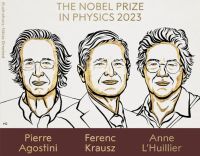
The Nobel Prize in Physics 2023 was awarded to Pierre Agostini, Ferenc Krausz and Anne L’Huillier "for experimental methods that generate attosecond pulses of light for the study of electron dynamics in matter".
The 2023 Laureates are colleagues of the JRML AMO group, publishing papers with all of them (more than 30 publications together). In particular, Cosmin Blaga, assistant professor at K-State, is a long-time collaborator of Pierre Agostini, who was Blaga’s co-mentor at the Ohio State University. Agostini delivered a physics colloquium at K-State in 2005; Krausz and L'Huillier both attended the 2nd International Conference on Attosecond Physics hosted here in 2009.
K-State was selected to host that meeting because of the research that was going on in the JRML, whose members Zenghu Chang (now at the University of Central Florida), Lew Cocke (professor emeritus), and Chii-Dong Lin made important early contributions to the field of attosecond science. The lab will continue working in this area of research, which will receive a new boost with the arrival of new faculty hire Meng Han whose main area of expertise is generation, characterization and applications of attosecond light pulses.
Today's AMO research is fertile ground, having been the focus of the Physics Nobel in 2018, 2022 and 2023.
September 2023
Charge Migration
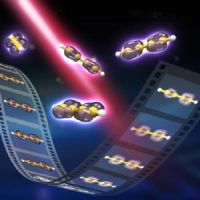
K-State University Distinguished Professor Chii-Dong Lin, together with collaborators from Huazhong University and the University of Connecticut, recently proposed a high harmonic spectroscopy (HHS) method for measuring the charge migration (CM) speed in a carbon-chain molecule, butadiyne (C4H2). The principle of HHS is based on the three-step model of high-order harmonic generation (HHG): ionization, acceleration, and recombination. Strong field ionization first creates a hole wave packet in the ion, which evolves in the laser field and is probed by the returning electron wave packet at the recombination moment, with the hole dynamics recorded in the generated harmonic spectra. The researchers used a two-color HHS scheme in combination with an advanced machine learning reconstruction algorithm to reconstruct the CM in C4H2 at the most fundamental level for each single fixed-in-space angle of the molecule. The method achieved a temporal resolution of 50 as. From analyzing the experimental results, they found that the charge migration speed ranges from 4.5 Å/fs to 2.9 Å/fs, for molecules oriented from parallel to perpendicular to the laser field direction. Here Å/fs ( Angstrom / femtosecond) is 100 km/s. For comparison, the speed of an Olympian sprinter is about 0.1 km/s.
This work was reported in the SPIE journal Advanced Photonics in August 2023 and in a SPIE press release, on which this description is based.
April 2023
CXFEL
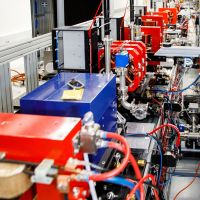
Two Kansas State University physicists are part of a team that has been awarded $90.8 million from the National Science Foundation to create a Compact X-ray Free-Electron Laser, or CXFEL, facility to study materials at an atomic level.
Artem Rudenko, Cortelyou-Rust professor of physics and director of the James R. Macdonald Laboratory, and Daniel Rolles, associate professor of physics, will contribute atomic, molecular and optical physics expertise to the diverse collaboration led by Arizona State University. K-State will receive $242,248 over five years for Rudenko and Rolles to help build the facility's electron-ion coincidence instrument.
This investment by the National Science Foundation, or NSF, through its Mid-scale Research Infrastructure-2 award supports cutting-edge science and engineering research infrastructure by underwriting the construction of unique instruments that provide deep, multidimensional information needed for transformative discoveries in a wide range of disciplines.
Details of the new machine are at the Arizona State Biodesign Institute.
March 2023
K-State Physics on APS TV
APS TV and Kansas State University are proud to present a new video on Physics at K-State. Kansas is more often associated with agriculture, tornadoes and empty space than with high-level science and technology, and changing this perception is the central goal of the film. Current cutting-edge physics research at K-State focuses on the areas of Atomic, Molecular and Optical (AMO) physics (here at the J. R. Macdonald Lab) and high-energy physics/cosmology, specifically highlighting the very high level of support by the United States Department of Energy (DOE). Our association with other large-scale scientific facilities is also a highlight.
APS TV is a partnership between the American Physical Society and the international film and broadcasting company WebsEdge. You can find the full WebsEdge Science APS playlist on YouTube.
The full length (05:10) video is also on our own K-State Physics YouTube channel, of course.
October 2022
Nobel Prize in Physics
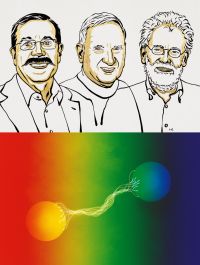
The Nobel Prize in Physics 2022 was awarded to Alain Aspect, John Clauser and Anton Zeilinger, who demonstrated the potential to investigate and control particles that are in entangled states. What happens to one particle in an entangled pair determines what happens to the other, even if they are really too far apart to affect each other. The laureates’ development of experimental tools has laid the foundation for a new era of quantum technology.
The fundamentals of quantum mechanics are not just a theoretical or philosophical issue. Intense research and development are underway to utilise the special properties of individual particle systems to construct quantum computers, improve measurements, build quantum networks and establish secure quantum encrypted communication. This year’s laureates have explored these entangled quantum states, and their experiments laid the foundation of the revolution currently underway in quantum technology.
A graduate of our AMO program, Hai Nguyen, served as a post-doc to Alain Aspect. Hai now works as a senior scientific advisor to the US Department of Defense and has twice returned to deliver colloquia.
July 2020
Ultrafast Ring Opening
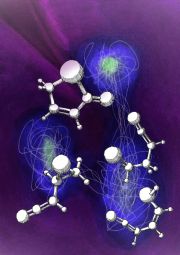
K-State physicists have taken extremely fast snapshots of light-induced molecular ring-opening reactions — similar to those that help a human body produce vitamin D from sunlight. The research is found in Nature Chemistry and popularly explained in a K-State press release.
"Think of this as stop-motion like a cartoon," said Daniel Rolles, associate professor of Physics and the principal investigator. "For each molecule, you start the reaction with a laser pulse, take snapshots of what it looks like as time passes and then put them together. This creates a 'molecular movie' that shows how the electronic structure of the molecule changes as a function of how much time passes between when we start and when we stop."
Shashank Pathak, doctoral student and lead author on the paper, said the idea was to study the dynamics of how a ring opens in a molecule on the time scale of femtosecond, which is one quadrillionth of a second. The researchers use a free-electron laser to visualize how these reactions happen by recording electron energy spectra as the atoms in the molecule move apart.
May 2020
FLAME Preparations

Before the pandemic shutdown we were anticipating the arrival of our newest laser system, FLAME. We cleared out and remodeled the magneto-optic trap lab (MOTRIMS) and moved the Kansas Light Source (KLS) there. We then remodeled the old KLS space to accommodate FLAME. We have a photo gallery of the preparations for your enjoyment.
FLAME (Femtosecond LAser for Multi-color Experiments) is a commercial 3-KHz, 5-mJ, 25-fs laser system that will drive several tunable light sources from the infrared to the extreme ultraviolet to allow for multi-color pump-probe experiments investigating light-induced processes in a variety of gas-phase samples. It supports a large number of experiments funded by the U.S. Department of Energy (DOE), DOE EPSCoR, and the National Science Foundation (NSF).
Completion of the project is obviously subject to the vagaries of the pandemic, but our current best-guess is August. Stay tuned for more updates on our progress.
May 2019
Distinguished Professor
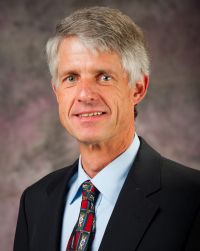
James R. Macdonald Laboratory theoretical physicist Uwe Thumm has been named a University Distinguished Professor. Uwe joins a long line of Physics professors who have been so honored. Current Distinguished Professors in the Physics department include Itzik Ben-Itzhak, Brett Esry, CD Lin, Bharat Ratra and Chris Sorenson. Retired or otherwise past professors include Lew Cocke, Pat Richard, Dean Zollman, Talat Rahman and Bill Reay. Clearly, we're doing something right!
Distinguished Professor is a lifetime title that is the highest honor the University bestows on its faculty for demonstrating their commitment to education through their excellence in teaching, research, creative endeavors and service. Five University faculty members were so honored this year.
Uwe's research focuses on resolving in time and space the motion of electrons and nuclei in ion-surface interactions and during the fragmentation of small molecules by ultra short and intense laser light pulses. Uwe also does research on the theory of atomic structure and particle - surface interactions. He is also recipient of the 2014 Humboldt Research Award and was named the 2015 Commerce Bank Distinguished Graduate Faculty member.
Nov 2018
How To Use An FEL
JRM Professor Daniel Rolles and his group have published a video article in JoVE, the Journal of Visualized Experiments. They describe the key steps for performing and analyzing pump-probe experiments combining a femtosecond optical laser with a free-electron laser in order to study ultrafast photochemical reactions in gas-phase molecules. This work utilizes the CAMP instrument at FLASH, a soft x-ray free electron laser that is part of the German DESY laboratory. Daniel has also been newly awarded a National Science Foundation Faculty Early Career Development (NSF CAREER) grant.
Oct 2018
Nobel Prize in Physics
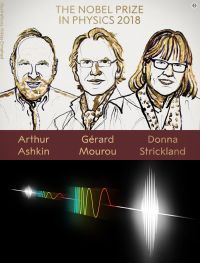
The Nobel Prize in Physics 2018 was awarded for groundbreaking inventions in the field of laser physics with one half to Arthur Ashkin "for the optical tweezers and their application to biological systems", the other half jointly to Gérard Mourou and Donna Strickland "for their method of generating high-intensity, ultra-short optical pulses".
Strickland and Mourou invented the chirped pulse amplification (CPA) technique for optical pulses used in the high-power ultrashort pulse lasers of the JRM Lab. JRM researchers have, in fact, enjoyed collaborations with Gérard Mourou.
The CPA technique proceeds in three steps: 1) an ultra-short laser pulse is stretched in time by several orders of magnitude, so that its peak power is correspondingly reduced, 2) it is amplified in a laser material without damaging it, 3) it is compressed in time back to its original duration, resulting in very high peak power. The short, powerful light generated makes possible the study of strong-field physics and high-speed interaction of light, atoms and molecules.
Apr 2018
Attosecond & Strong-Field Physics
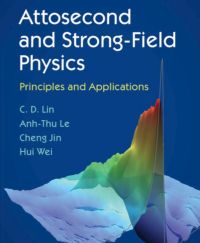
Present and past researchers with the JRM Lab have published a new book, Attosecond and Strong-Field Physics: Principles and Applications. The book is published by Cambridge University Press and will be available in print and electronic form in June from booksellers everywhere.
CD Lin, Anh-Thu Le, Cheng Jin, and Hui Wei collaborated to produce the volume. Aimed at beginning graduate students, the book provides an intuitive approach to these emerging fields, utilizing simplified models to develop a clear understanding of how matter interacts with intense attosecond pulses of light.
An introductory chapter outlines the structure of atoms and molecules and the properties of a focused laser beam. Detailed discussion of the fundamental theory of attosecond and strong-field physics follows, including the molecular tunnelling ionization model (MO-ADK theory), the quantitative rescattering (QRS) model, and the laser induced electronic diffraction (LIED) theory for probing the change of atomic configurations in a molecule. Highlighting the cutting-edge developments in attosecond and strong field physics, and identifying future opportunities and challenges, this self-contained text is invaluable for students and researchers in the field.
Jun 2017
Femtosecond Response

JRM researchers and their collaborators have published unexpected results in Nature.
This work used short pulses of ultra-intense high-energy X-rays to produce a detailed picture of how radiation interacts with molecules. This was the first time this kind of extreme light has been used to break up molecules, and may help scientists understand the damages from X-ray radiation.
In experiments using either soft or less-intense hard X-rays, it was thought that the induced charge and associated radiation damage of atoms in polyatomic molecules can be inferred from the charge that is induced in an isolated atom under otherwise comparable irradiation conditions. Here it seems that the femtosecond response of small polyatomic molecules that contain one heavy atom to ultra-intense, hard X-ray pulses is qualitatively different: experimental and modeling results establish that, under these conditions, the ionization of a molecule is considerably enhanced compared to that of an individual heavy atom with the same absorption cross-section. The heavy atom tears electrons from the other atoms, something like a molecular black hole.
Popularizations of this paper can be found in Scientific American and Newsweek, and in press releases from K-State, DESY and SLAC.
May 2017
Ultrafast & Ultrasmall
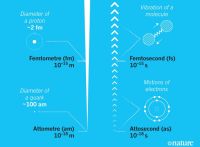
Nature has published a tutorial on current research into the realms of the ultrafast and ultrasmall, including work done here in the JR Macdonald Laboratory.
"Their goal is to film events that take place in picoseconds (ps, 10-12 s) or femtoseconds (fs, 10-15 s), with atoms moving mere picometres (a hydrogen atom is roughly 100 pm in diameter). At this resolution, researchers can for the first time directly observe a molecule writhing in slow motion, atomic bonds vibrating and breaking, or even electrons washing back and forth. As these techniques become more mainstream, the pay-offs could be huge."
One of the ideas for using a laser to record a few femtoseconds of a molecule's extremely fast vibrations as it breaks apart came from Kansas State University physicists. Chii-Dong Lin, university distinguished professor of physics, and Anh-Thu Le, research associate professor in James R. Macdonald Laboratory, who are part of an international collaborative project which published in the Oct. 21 issue of Science.
That work was highlighted in a recent JRM Lab feature story. Many more on similar topics are also available.
Oct 2016
Ultrafast Imaging
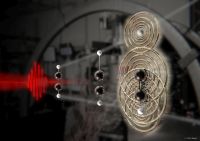
Lasers have successfully recorded a chemical reaction that happens as fast as a quadrillionth of a second, which could help scientists understand and control chemical reactions.
The idea for using a laser to record a few femtoseconds of a molecule's extremely fast vibrations as it breaks apart came from Kansas State University physicists. Chii-Dong Lin, university distinguished professor of physics, and Anh-Thu Le, research associate professor in James R. Macdonald Laboratory, are part of an international collaborative project published in the Oct. 21 issue of Science.
Working with those ideas, scientists at the European Institute for Photonic Science (ICFO), used an electron-imaging technique to capture the predissociated state of acetylene molecule just 9 fs after its ionization. On this time scale, the departing hydrogen atom and the remaining molecular fragment form an aloof complex in which the electronic coherence required to form bonds between the two is not yet fully lost. Imaging such transient states under different optical excitation conditions with high spatiotemporal resolution holds key information on selective photochemistry that may enable control of chemical reactions.
(See also the Science article, the overview Science Perspective and the K-State or ICFO press releases.)
Apr 2016
Superheated Nanoparticles
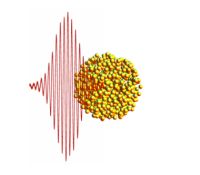
Think of it as a microscopic movie: A sequence of X-ray images shows the explosion of superheated nanoparticles. The picture series reveals how the atoms in these particles move, how they form plasma and how the particles change shape.
The method of taking these pictures is a collaborative creation that involved Kansas State University researchers Artem Rudenko and Daniel Rolles, both assistant professors of physics.
"We can create a real movie of the microworld," Rudenko said. "The key development is that now we can take sequences of pictures on the nanoscale."
Rudenko and Rolles — both affiliated with the university's James R. Macdonald Laboratory — collaborated with researchers at SLAC National Accelerator Laboratory at Stanford University, Argonne National Laboratory and the Max Planck Institutes in Germany. Their publication, "Femtosecond and nanometre visualization of structural dynamics in superheated nanoparticles", appears in Nature Photonics. You may also read the K-State news release.
Jan 2016
The Optical Society Centennial
In 2016 The Optical Society (OSA) will be highlighting its past, present and future on the occasion of its 100th anniversary. Various events and a special web site will focus on where the society is today, and on its future.
Founded in 1916, OSA is the leading professional association in optics and photonics, home to accomplished science, engineering, and business leaders from all over the world. Through world-renowned publications, meetings, and membership programs, OSA provides quality information and inspiring interactions that power achievements in the science of light.
Many of the JRM faculty are OSA members, and we host a student branch known as the Kansas Optical Society (KOS). The KOS was established at Kansas State University in April 2013. Its mission is to gather students interested in optics and photonics in a causal environment to discuss science, promote optics knowledge in central Kansas, and foster professional development through various activities. Membership is open to any undergraduate or graduate student in the state of Kansas who is interested in expanding their knowledge in optics, photonics and other closely related fields.
Jan 2015
International Year of Light

This year is the International Year of Light and Light-based Technologies (IYL), a global initiative which will highlight to the citizens of the world the importance of light and optical technologies in their lives, for their futures, and for the development of society. It is an unique opportunity to inspire, educate, and connect on a global scale.
An opening ceremony was held at the headquarters of UNESCO in Paris. Delegates included representatives from the UN and UNESCO as well as Nobel laureates Zhores Alferov, Steven Chu, Serge Haroche and William Phillips. The IYL will eventually involve more than 100 partners from 85 countries.
At the James R. Macdonald Laboratory we study Atomic, Molecular and Optical (AMO) physics, with a special emphasis on the interactions of light and matter. We will be joining the celebration through our participation in the American Physical Society's (APS) Division of Atomic, Molecular and Optical Physics (DAMOP) conferences this spring.
The APS is also making freely available various history-making science papers relating to light, including those describing the invention of the laser and others outlining how photonics technology has become part of our daily lives.
Jul 2014
Imaging Charge Transfer
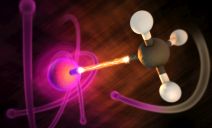
Ultrafast X-ray laser research led by Kansas State University physicists has provided scientists with a snapshot of a fundamental molecular phenomenon. The finding sheds new light on microscopic electron motion in molecules.
Artem Rudenko, assistant professor of physics and a member of the James R. Macdonald Laboratory; Daniel Rolles, currently a junior research group leader at Deutsches Elektronen-Synchrotron in Hamburg, who will be joining the university's physics department in January 2015; and an international group of collaborators studied how an electron moves between atoms in an exploding molecule.
Researchers measured at which distances between the two atoms the electron transfer can occur. Charge transfer processes — particularly electron transfer — are important for photosynthesis, in solar cells, and drive many other important reactions in physics, chemistry and biology. Their paper and a Perspective commentary on it appear in the journal Science, and K-State has a popular summary.
"There is a very fundamental question about how far an electron can go to reach the nearby atom in a molecule, and how probable that transition is," Rudenko said. "It has been difficult to capture images of this motion because of the very short times and very small distances that need to be measured."
Mar 2014
Elucidating Isotopic Effects
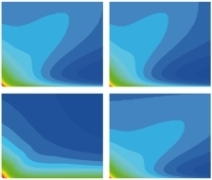
JRM scientists have made the cover of the Journal of Physics B: Atomic, Molecular and Optical Physics.
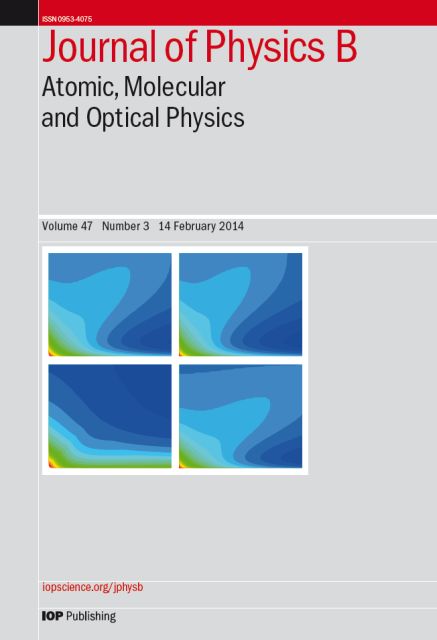
The triatomic hydrogen molecular ion has attracted interest in fields as diverse as chemistry and astronomy. It has also gained attention from the strong-field laser community since, being the most basic stable polyatomic molecule, it could be pivotal to our understanding of laser-driven molecular dynamics.
Earlier work explored the strong-field fragmentation of H3+ and D3+ molecules. New research focuses on the isotopologue D2H+. In many ways this member of the H3+ family could be considered more exciting than its counterparts as it naturally poses the question of whether there are any isotopic effects arising from the mass-asymmetry of the D2H+ ion.
Using a crossed-beams coincidence 3D momentum imaging method we can separate all the possible fragmentation channels of D2H+ in intense, ultrashort laser pulses. This lets us find the branching ratios of break-up channels differing by the isotope. Notably we see sizeable differences in some channels. We visualize and qualitatively explain these findings based on the topology of the potential energy surfaces of this molecular system, using mass-scaled coordinates.
Dec 2013
Adaptive Strong-Field Control
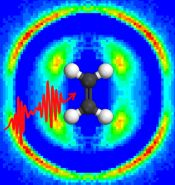
In a recent Nature Communications, researchers from Kansas State, Augustana College, the Max Planck Institute for Quantum Optics and the Ludwig Maximilian University have reported an improved adaptive feedback technique for shaping laser pulses to do molecular manipulation.
Pulse shaping can manipulate dynamics in molecules, but extracting information from the optimized pulse remains difficult. Experimental constraints often limit feedback to a single observable, complicating efforts to decipher the underlying mechanisms and parameterize the search process. We have shown, using two strong-field examples, that by rapidly inverting velocity map images of ions to recover the three-dimensional photofragment momentum distribution and incorporating that feedback into the control loop, the specificity of the control objective is markedly increased.
Eric Wells of Augustana built on initial work done at the Max Planck Institute. The Augustana researchers travelled here to conduct the experiment as part of a long-standing collaboration. Together we have been successful in giving undergraduates from schools like Augustana an opportunity to work in a world-class lab. Several Augustana undergraduates participating have joined K-State's graduate program, including Nora Kling, who recently completed her studies, and Bethany Jochim, who received a prestigious DOE fellowship.
Oct 2013
ITAMP Workshop
From 04 - 06 November the JRM Lab will host a workshop for the Institute of Theoretical Atomic, Molecular and Optical Physics (ITAMP). The workshop will explore "Ultrafast atomic and molecular physics with cutting-edge light sources: New opportunities and challenges".
This workshop brings together experimentalists and theorists working on strong-field, ultrafast laser interactions with atoms and molecules. In particular, the workshop will focus on attosecond, few-cycle, and ultra-broadband pulses - all rather broadly interpreted - emphasizing what can be measured or controlled with them rather than their production.
This workshop also brings together a diverse group of researchers, including attophysicists, femtochemists, multidimensional spectroscopists, x-ray and FEL physicists, and those who have used half-cycle and shaped pulses on Rydberg systems. We aim for cross-fertilization from the more established of these disciplines to the newer ones to build on the hard won expertise already developed.
July 2013
VUVX Conference Award
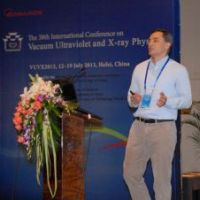
Artem Rudenko has received the VUVX Conference Award in Atomic, Molecular and Optical Physics “for his exceptional contributions to laser and X-ray science in atomic and molecular physics. Using ultra-short and phase stabilized laser pulses and Free-Electron Lasers, he has been the driving force for benchmark experiments from the VUV to the X-ray regime.”
The VUVX Conference Award recognizes outstanding experimental and/or theoretical contributions to the scientific areas of relevance to this conference series, ranging from condensed matter studies to gas-phase and cluster research. It is to be awarded to a scientist in mid-career, who has made significant contributions to the field over the past decade or more. Nominations are solicited from the VUVX International Scientific Committee and the VUVX community at large.
Artem presented an award talk on "Time-resolved imaging of non-local relaxation processes upon inner-shell photoionization".
June 2013
Laser-Induced Electron Diffraction
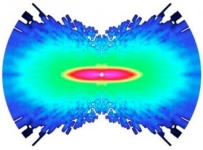
In 2012, researchers from Ohio State University and Kansas State University demonstrated the ability to take "snapshots" of a vibrating molecules on a femtosecond time scale using laser-induced electron diffraction (LIED). This year, that work has been extended and generalized. Originally published in Physical Review Letters, the work then received distinction as a research highlight in Nature Photonics.
This work was a collaboration between the group of Louis DiMauro at Ohio State University with our own University Distinguished Professor CD Lin and his group, including then-student, Junliang Xu.
The LIED technique illuminates molecules with intense, ultrafast laser light pulses. The powerful laser electric field both ionizes the molecule and causes some electrons to be rescattered from the parent molecule. The electrons produce a diffraction pattern that can be used to to produce the images with sub-Angstrom precision and exposure times of a few femtoseconds.
The new paper, entitled "Laser-Induced Electron Diffraction for Probing Rare Gas Atoms" was published in PRL, and in turn received notice in Nature Photonics.
Read more news from the lab, or find still more of our world-class AMO physics publications.
November 2012
Supercharged Ionization
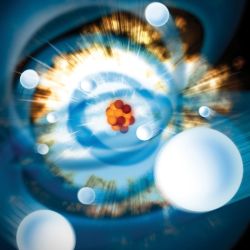
A collaboration including our own Artem Rudenko has used the Linac Coherent Light Source (LCLS) to find a way to strip most of the electrons from Xenon atoms, creating a “supercharged”, strongly positive state at energies previously thought too low. The work, "Ultra-efficient ionization of heavy atoms by intense X-ray free-electron laser pulses" was recently published by Nature Photonics.
Beside Artem, the research team includes scientists from 19 research centers from around the world. The LCLS is a new facility at the US Department of Energy’s SLAC National Accelerator Laboratory.
The finding has received a great deal of attention, including a story on the popular technology site, Slashdot.
September 2012
Intense Tunable Fast Laser
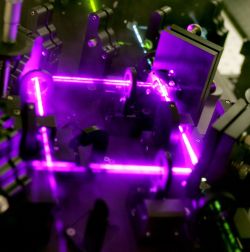
A multi-disciplinary, multi-institution team headed by Carlos Trallero has received a National Science Foundation (NSF) Major Research Infrastructure (MRI) grant. The team proposes the "Acquisition of a High Intensity Tunable Femtosecond Laser".
The laser source is also partially funded by an Air Force Defense University Research Instrumentation Program (DURIP) grant recently awarded to the Macdonald Lab.
Such a laser would create milli-Joule (mJ) level, few-cycle pulses (10 fs to 14 fs) in the mid-infrared (1400-2200 nm) spectral region that are carrier-envelope phase stable. To generate these pulses, a white-light seeded optical parametric amplifier (OPA) is pumped by a 20 mJ femtosecond laser. The pulses emerging from the OPA are then spectrally broadened and compressed. Such capabilities are at the forefront of current ultrafast physics and attosecond science, opening a window for new and exciting studies in the general area of laser-matter interaction.
April 2012
Distinguished Professor
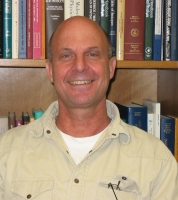
James R. Macdonald Laboratory director Itzik Ben-Itzhak has been named a University Distinguished Professor. Itzik joins a long line of Physics professors who have been so honored. Current Distinguished Professors in the Physics department include Brett Esry, CD Lin, Chris Sorenson and Dean Zollman. Retired or otherwise past professors include Lew Cocke, Pat Richard, Talat Rahman and Bill Reay. Clearly, we're doing something right!
Distinguished Professor is a lifetime title that is the highest honor the University bestows on its faculty for demonstrating their commitment to education through their excellence in teaching, research, creative endeavors and service. Four University faculty members were so honored in 2012.
Itzik's research focuses on the interaction of intense ultrashort laser pulses with molecular ions, with the long-term goal of gaining sufficient understanding of these processes so that they may be controlled at the quantum mechanical level. He also studies the physics of atomic and molecular collisions.
Read more about Itzik's honor in the University press releases, or see the photo gallery of the party thrown for him earlier this month.
March 2012
Imaging Ultrafast Molecular Dynamics
Real-time images of two atoms vibrating in a molecule have been made by the experimental group of Louis DiMauro at Ohio State University, in collaboration with our own University Distinguished Professor CD Lin and his student Junliang Xu.
The technique illuminates nitrogen or oxygen molecules with intense, ultrafast laser light pulses. The powerful laser electric field both ionizes the molecule and causes some electrons to be rescattered from the parent molecule. The electrons produce a diffraction pattern that can be used to to produce the images with sub-Angstrom precision and exposure times of a few femtoseconds.
The paper, entitled "Imaging ultrafast molecular dynamics with laser-induced electron diffraction" was published in the prestigious journal Nature, and in turn received widespread attention in the popular media. Popular stories can be found on the Gizmodo blog and in the Columbus Dispatch newspaper.
Read more news from the lab, or find still more of our world-class AMO physics publications.
February 2012
Research Highlights
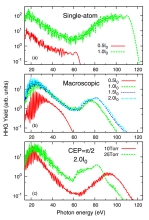
JRM AMO researchers have recently been recognized for the special merit of papers published in the Journal of Physics B: Atomic, Molecular and Optical Physics.
Matthias Kling contributed to "Attosecond imaging of XUV-induced atomic photoemission and Auger decay in strong laser fields". Published in May 2011, this paper has been chosen as a 2011 Highlight, giving "a taste of the outstanding and excellent research published" by J. Phys. B in 2011. See J. Phys. B 44, 105601 .
Carlos Trallero, CD Lin, AT Le and Cheng Jin were co-authors of "Generation of broad XUV continuous high harmonic spectra and isolated attosecond pulses with intense mid-infrared lasers". This work was chosen in December of 2011 as an IOP Select paper for its "novelty, significance and potential impact on future research". See J. Phys. B 45, 011001 .
Read more news from the lab, or find still more of our world-class AMO physics publications.
January 2012
Ad Astra!
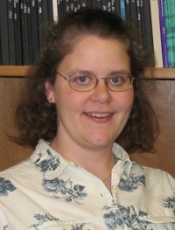

We are wrapping up the Kansas sesquicentennial celebrations, and the Ad Astra Kansas Initiative is spotlighting 150 Kansas researchers, inventors and engineers from the past to the present who have advanced their field. The latest to be so recognized is our own Associate Professor, Kristan Corwin. She joins our Professor Chii-Dong Lin, who was also so honored this past summer.
The Ad Astra Kansas Initiative is a Hutchinson-based organization that works toward promoting the scientific accomplishments of Kansas researchers and innovators who work in the fields of science, technology, engineering and mathematics. Ad Astra's project, "Science in Kansas: 150 Years and Counting," celebrates the state's sesquicentennial. It is meant to emphasize the importance of science and the career possibilities in research and innovation to K-12 students.
Learn more from the Kansas State University press release or the Ad Astra Kansas Initiative web site.
October 2011
A New Kind of Laser
Associate Professors Brian Washburn and Kristan Corwin, along with graduate student Andrew Jones have invented a new class of lasers. The laser light is generated by gas confined within hollow "photonic crystal" fibers.
The project is being funded by the Army Research Office, the Air Force Office of Scientific Research, and Precision Photonics Corp. in Colorado. The work is in collaboration with Chris Levy in the K-State Chemistry Department, the University of New Mexico and the University of Bath in the U.K.
September 2011
Jochim Wins Apker Award
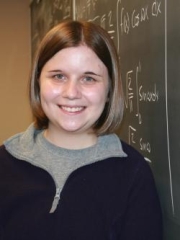
A Kansas State University graduate student is receiving a prestigious physics award for research she did as an undergraduate with the help of the J.R. Macdonald Laboratory.
Bethany Jochim, doctoral student in physics from Pierre, SD, is the recipient of the LeRoy Apker Award, the top undergraduate honor awarded by the American Physical Society. The award recognizes outstanding achievements in physics. Two Apker awards are given annually. Each award consists of $5,000 to the recipient, a travel allowance to the American Physical Society meeting where the award will be presented, and $5,000 to the recipient's undergraduate institution.
Jochim is a 2011 bachelor's graduate of Augustana College in Sioux Falls, SD, where she had a successful career as an undergraduate researcher, working with her advisor, K-State alumnus Eric Wells. She had five research articles published in mainstream peer-reviewed scientific journals. Some of this research work was conducted here at the JRM Lab.
August 2011
Ad Astra!
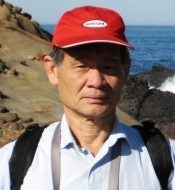
We are currently celebrating the Kansas sesquicentennial, and the Ad Astra Kansas Initiative is spotlighting 150 Kansas researchers, inventors and engineers from the past to the present who have advanced their field. The latest to be so recognized is our own Associate Director for Theoretical Research and University Distinguished Professor, Chii-Dong Lin,
The Ad Astra Kansas Initiative is a Hutchinson-based organization that works toward promoting the scientific accomplishments of Kansas researchers and innovators who work in the fields of science, technology, engineering and mathematics. Ad Astra's project, "Science in Kansas: 150 Years and Counting," celebrates the state's sesquicentennial. It is meant to emphasize the importance of science and the career possibilities in research and innovation to K-12 students.
Learn more from the Kansas State University press release or the Ad Astra Kansas Initiative web site.
June 2011
Informal Physics
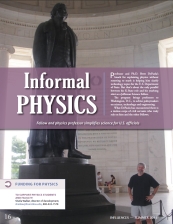
Professor and Ph.D. Brett DePaola’s knack for explaining physics without resorting to math is helping him clarify technology topics for the U.S. Department of State. But that’s about the only parallel between his K-State role and his yearlong stint as a Jefferson Science Fellow.
The program brings professors to Washington, D.C., to advise policymakers on science, technology and engineering.
What DePaola has encountered there is a tireless corps of civil servants who truly rely on him and the other Fellows...
From Informal Physics in the Summer 2011 issue of Influences, a publication of the Kansas State College of Arts & Sciences. Read the complete article or the entire publication in Acrobat (pdf) format.
May 2011
Electron Ping Pong
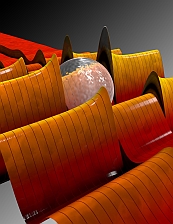
An international team of researchers, including our own Matthias Kling, succeeded at the Max Planck Institute of Quantum Optics to control and monitor strongly accelerated electrons from nano-spheres with extremely short and intense laser pulses.
When intense laser light interacts with electrons in nanoparticles that consist of many million individual atoms, these electrons can be released and strongly accelerated. Such an effect in nano-spheres of silica was recently observed by an international team of researchers in the Laboratory for Attosecond Physics (LAP) at the Max Planck Institute of Quantum Optics. The researchers report how strong electrical fields (near-fields) build up in the vicinity of the nanoparticles and release electrons. Driven by the near-fields and collective interactions of the charges resulting from ionization by the laser light, the released electrons are accelerated, such that they can by far exceed the limits in acceleration that were observed so far for single atoms. The exact movement of the electrons can be precisely controlled via the electric field of the laser light.
Read the complete press release from MPI, or the original paper in Nature Physics: Controlled near-field enhanced electron acceleration from dielectric nanospheres with intense few-cycle laser fields.
April 2011
Lew Cocke Is Retiring
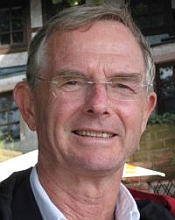
During his exceptional career Lew Cocke made outstanding contributions to atomic, molecular and optical physics. He has been a prolific researcher and mentor who, over many decades, led the scientific work at the J. R. Macdonald Laboratory in the KSU Department of Physics. At the end of this Spring semester, Lew will officially retire as a University Distinguished Professor and become a Professor Emeritus. Even though Lew plans to continue conducting research in the coming years, this juncture of his career is an appropriate time to recognize his contributions to AMO physics. We, as his colleagues, and the KSU Department of Physics, are organizing a celebration of this special occasion with a one-day symposium entitled Chasing attosecond dynamics of atoms and molecules with electrons, ions and lasers - the last forty years.
The Lew Cocke Symposium will be held at the KSU Alumni Center on Monday, 18 April 2011.
Fall 2010
Imaging A Chemical Reaction
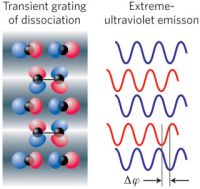
Gaining complete control over chemical reactions has been the dream of chemists and physicists for decades. To achieve this goal, one must first be able to follow and characterize (or 'image') the dynamics of the coupling between electronic and nuclear motion within molecules on a femtosecond timescale. This has been traditionally achieved using the pump–probe scheme, which involves delaying two ultrashort laser pulses with respect to each other. The first pulse — the pump — creates excited states in molecules to initiate a chemical reaction. These molecules are then imaged by a second pulse — the probe — at different points in time following the excitation. Because ultrashort pump pulses can typically excite only a small fraction of molecules at a time, signals from molecules undergoing chemical transformation are much weaker than signals from ground-state molecules, thus making the task technically challenging.
The full text is found in
"Ultrafast optics: Imaging a chemical reaction"
Anh-Thu Le, Chii-Dong Lin
Nature Photonics
4,
671
(2010)
Summer 2010
Summer Undergrad Research
The Physics Department and the JRM Lab have just concluded another successful summer Research Experience for Undergraduates (REU). The REU program is funded by the National Science Foundation and is managed here by Professors Kristan Corwin and Larry Weaver. Undergraduates from around the country are mentored through an intensive ten weeks of hands-on work by various faculty members.
The KSU Graduate School and the Division of Communications and Marketing have produced the above video highlighting not only the Physics REU program, but undergrad research across the University. Another KSU press release describes the research of one of our students, Jennifer Black of Southern Polytechnic State University in Georgia, mentored by Professor Brian Washburn.
March 2010
Ultracold Controlled Chemistry
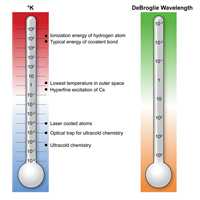
Two groups have now taken a completely new approach to study chemical transformations of molecules: Steven Knoop and colleagues at the University of Innsbruck in Austria and the Austrian Academy of Sciences, in collaboration with Jose D'Incao at JILA and Brett Esry at Kansas State University, both in the US, reporting in Physical Review Letters, and Silke Ospelkaus and co-workers at JILA and NIST, also in the US. These researchers start with an ensemble of atoms cooled to an ultralow temperature (<10 µK) and confined in an optical potential of a focused laser beam. The atoms are then linked together by a time-varying magnetic field in the work of Knoop et al., or by irradiating the sample of atoms with lasers of two different frequencies in the work of Ospelkaus et al.
From a Physics Viewpoint article by Roman V. Krems, on a recent Physical Review Letters paper by our Brett Esry and his collaborators.
November 2008
The Attosecond Revolution
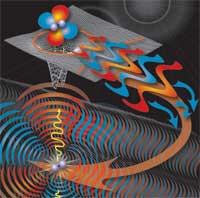
The most intuitive way to understand the extreme nonlinear interaction that leads to attosecond pulses is through the semi-classical re-collision model. A strong infrared light pulse illuminating an atom or molecule creates a "free" electron wave packet by multiphoton ionization, usually approximated by tunneling. Tunneling occurs over a range of phases of the fundamental pulse near each crest of the laser electric field - a time window of roughly 300 attoseconds (as). In practice, in the infrared, multiphoton ionization intensities in the range of 1014 to 1015 W/cm2 are needed, corresponding to peak electric field strengths of 3-10 V/Å...
This article by Paul Corkum and Zenghu Chang was the cover story in the October Optics & Photonics News. It is available in Acrobat form.
October 2008
Coulomb Explosion of D2
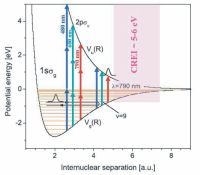
We present the first systematic wavelength-dependent study of laser Coulomb explosion of deuterium molecules at various peak intensities and polarizations. We measured the kinetic energy spectra of D+ for laser wavelengths in the range 480-2000 nm. In addition to the well-known enhanced ionization channel present for all wavelengths, we observe a new high-energy band at short wavelengths. This new band exhibits wavelength dependence, with fragment energy decreasing with increasing wavelengths until it merges with the enhanced ionization band for 800 nm and longer. We attribute the emergence of this band to a new pathway that involves resonant three-photon coupling to the first excited electronic state of the molecular ion during the Coulomb explosion process. This pathway should be accounted for in controlling molecular dynamics of hydrogen by intense laser pulses.
The full text is found in New Journal of Physics, 10, 83011 (07 Aug 2008).
September 2008
Femtosecond Dynamics
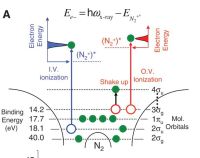
The direct observation of molecular dynamics initiated by x-rays has been hindered to date by the lack of bright femtosecond sources of short-wavelength light. We used soft x-ray beams generated by high-harmonic upconversion of a femtosecond laser to photoionize a nitrogen molecule, creating highly excited molecular cations. A strong infrared pulse was then used to probe the ultrafast electronic and nuclear dynamics as the molecule exploded. We found that substantial fragmentation occurs through an electron-shakeup process, in which a second electron is simultaneously excited during the soft x-ray photoionization process. During fragmentation, the molecular potential seen by the electron changes rapidly from nearly spherically symmetric to a two-center molecular potential. Our approach can capture in real time and with angstrom resolution the influence of ionizing radiation on a range of molecular systems, probing dynamics that are inaccessible with the use of other techniques.
The full text of this paper is found in Science, 317, 1374 (07 Sep 2007).
Last updated on Tuesday, 06-Feb-2024

